
A new driveway in Anne Arundel County is a civil engineering project that sits right in your front yard. The long-term success of a new driveway installation that Anne Arundel County homeowners invest in depends entirely on what happens beneath the surface. You likely know that local soil and the proximity to the Chesapeake Bay make water management a constant challenge. Dealing with local regulations can feel like a heavy burden, and the fear of a surface cracking after just two winters is a valid concern for any homeowner.
We understand that you want a reliable surface that adds value to your property without the headache of bureaucratic red tape. This guide provides the clarity you need to ensure your project stays smooth and durable for decades. We will show you how to navigate specific Maryland paving standards and handle complex drainage requirements to protect your investment. You will discover the technical steps required to meet right-of-way standards and the construction methods that prevent common sub-base failures.
Key Takeaways
- Identify the specific signs of structural failure that indicate your current surface has reached the point of no return.
- Navigate the standards for a new driveway installation required by Anne Arundel County to ensure your property meets all local entrance regulations.
- Learn how proper sub-base construction manages Maryland’s clay-heavy soil to prevent the surface from sinking or shifting over time.
- Evaluate the performance of different paving materials against the local climate and the repetitive freeze-and-thaw cycles of winter.
- Gain insight into how local expertise in the Annapolis and Gambrills regions ensures a paving project is completed the first time correctly.
Planning Your New Driveway Installation in Anne Arundel County
A driveway serves as the functional welcome to your home. In established neighborhoods throughout Annapolis and Gambrills, a clean and well-constructed surface acts as a primary driver of curb appeal. Beyond the visual impact, a new driveway installation Anne Arundel County residents choose to invest in is a significant structural upgrade. Proper planning ensures that this investment holds its value and performs reliably under the weight of daily traffic and the stresses of the local climate.
Success starts with a clear understanding of your current surface’s condition. While minor cracks are often manageable through routine maintenance, certain patterns of damage indicate that the foundation is no longer stable. Identifying these “point of no return” failures early prevents you from wasting money on temporary fixes that will not last through the next winter season.
When Replacement is Better Than Repair
Deciding between a patch and a full replacement requires a look at the history and structure of the pavement. Most asphalt surfaces have a functional lifespan of approximately 15 to 20 years. If your driveway is approaching this age, the internal binders have likely become brittle. You should look for deep structural cracks or areas of “alligatoring.” These clusters of small, intersecting cracks indicate that the sub-base has softened or shifted.
Patching a failed base is a short-term solution. Because the underlying ground is unstable, the new patch will eventually sink or crack along the same lines as the old damage. When you analyze the costs over a five year window, the price of repetitive repairs often surpasses the cost of a full new driveway installation Anne Arundel County project. A fresh start provides a stable foundation that protects your home’s accessibility for decades.
Defining Your Driveway Goals
Modern residential paving requires a customized approach. You must balance your aesthetic preferences with the practical needs of your household. Consider how you use the space today and how those needs might change. Many homeowners are now opting for wider layouts or circular entrance designs to accommodate multiple drivers or to provide easier access for guests.
Usage is a critical factor in the design phase. If you intend to store a boat, an RV, or heavy equipment, the driveway requires a thicker application of Asphalt concrete and a more robust base. You should also evaluate your property’s natural slope. Effective drainage management is the most important part of the planning process. Water must be directed away from the home and the edges of the pavement to prevent erosion and premature cracking.
Maryland’s high humidity and seasonal temperature swings make timing essential. Paving should occur during dry periods when the ground is not frozen. From the initial estimate to the final rolling, the process typically spans a few weeks of coordination, though the heavy construction usually finishes in a single day. A well-planned layout and schedule solve these logistical problems before the first load of material arrives on site.
Navigating Anne Arundel County Paving Permits and Regulations
Anne Arundel County views the connection between your private property and the public road as a critical infrastructure point. Every new driveway installation Anne Arundel County homeowners plan requires a Residential Driveway Access Permit before the project starts. This isn’t just a formality. The county uses this process to verify that your entrance doesn’t interfere with public safety, drainage, or road maintenance. It’s the first step in ensuring your home remains compliant with local building codes.
The county enforces strict design geometrics to keep residential streets safe. For homeowners desiring a circular entrance with two access points, the county typically mandates a minimum of 100 feet of road frontage. Without this space, the Department of Public Works may deny the request to protect traffic flow and visibility. You’re also responsible for identifying and relocating any utilities that sit within the path of the new pavement. We handle the logistical heavy lifting of the permit process so you don’t have to navigate the county’s Land Use Navigator system alone.
Right-of-Way Permit Essentials
A permit is mandatory for new installations and any modifications to your existing curb cut. The Department of Public Works reviews these applications to confirm that the pavement cross-sections are durable enough for daily use. They apply different standards depending on whether you live on an open-section road with drainage ditches or a closed-section road with curbs and gutters. These specifications dictate the thicknesses of the stone base and asphalt surface required to support vehicle loads.
Relying on an established guides ensures the transition to the county road is structurally sound. This technical alignment prevents the asphalt from cracking where your property meets the public street. When we design a new residential driveway, we focus on these transition points to ensure the edges don’t crumble under the pressure of turning tires.
Local Drainage and Environmental Compliance
Maryland maintains some of the nation’s strictest runoff and sediment control standards to protect the Chesapeake Bay. County inspectors look closely at the slope of your driveway. They want to see that water won’t dump onto the public road or cause erosion on adjacent lots. If your property is near a sensitive waterway, these rules become even more vital. Proper drainage geometries keep the water moving where it belongs and away from your foundation.
Matching the existing road grade is a technical requirement that prevents flooding. If the site grading is slightly off, water can pool at your entrance and destroy the sub-base. This standing water is the primary cause of potholes and early surface failure in our region. If you’re ready to start the planning phase, you can reach out to our office to discuss your property’s specific needs and schedule a site visit.

The Anatomy of a High-Quality Asphalt Driveway in Maryland
The black surface of a driveway is only its most visible layer. Underneath that smooth finish lies a complex system designed to support thousands of pounds of weight while resisting the elements. For a successful new driveway installation Anne Arundel County homeowners must look past the surface and focus on the foundation. Without a properly engineered sub-base, even the highest quality asphalt will fail prematurely under the stress of local traffic.
Maryland is known for its clay-heavy soil, which presents a unique challenge for paving. Clay is highly expansive. It absorbs water easily and swells, then shrinks as it dries. This constant movement can cause a driveway to shift and sink if the soil isn’t managed correctly. We replace unstable sub-soil with a thick layer of crushed stone to create a bridge between the soft earth and the rigid pavement. This stone base provides the necessary drainage and structural integrity to keep the driveway level for years.
Site Preparation and Grading
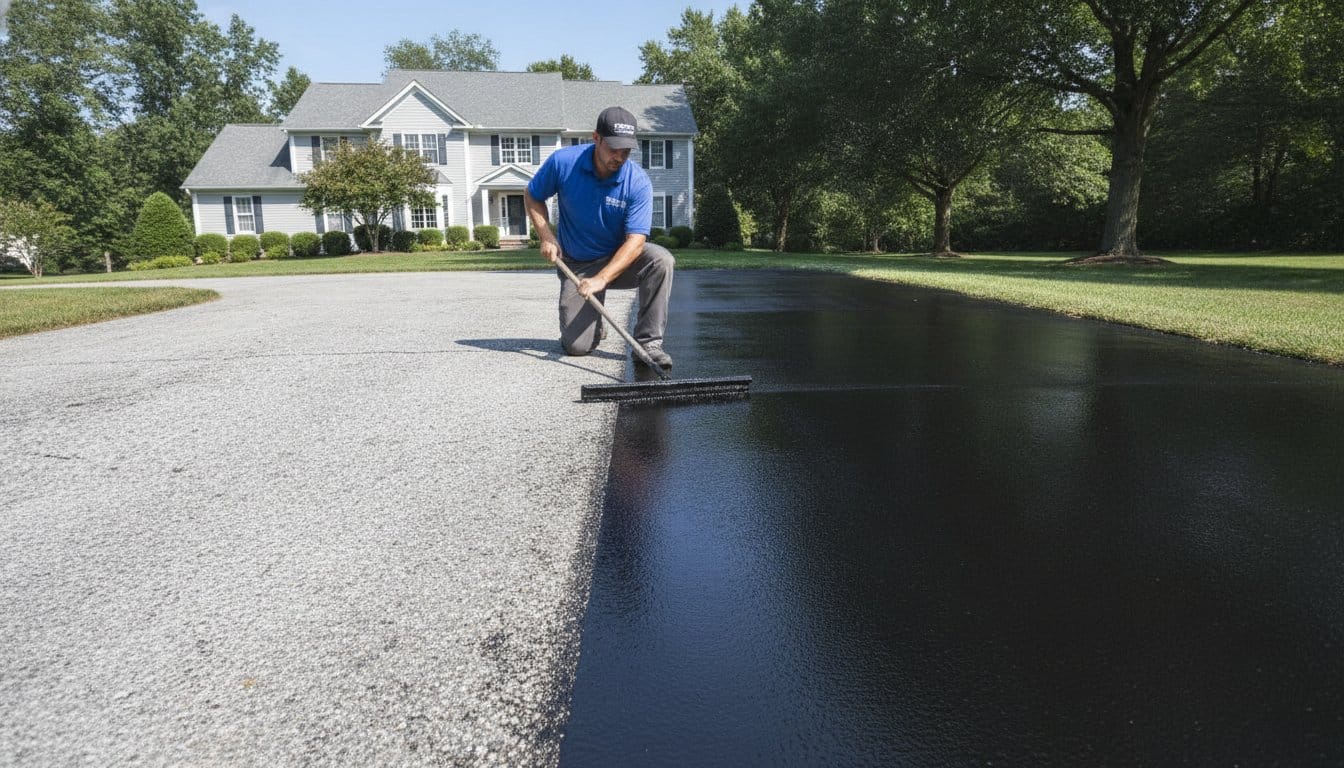
The process begins with the removal of all organic material and old pavement. We dig down to a solid foundation to ensure the new structure has a firm starting point. Proper site grading is then performed using laser-guided equipment. This technology allows us to achieve a precise slope, typically at least a 2% grade. This angle is essential because it directs water away from your home’s foundation and prevents it from seeping into the pavement edges. A well-compacted stone base is then installed to provide a stable platform that won’t settle over time.
Asphalt Application and Compaction
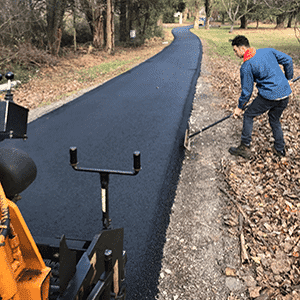
High-quality paving involves two distinct layers of material. The base coat, or binder layer, consists of larger stones and provides the primary structural strength. The surface coat is a finer mix that creates a smooth, water-resistant finish. For a standard new residential driveway, these layers are applied at a specific “hot mix” temperature. Maintaining this heat is vital in areas like Gambrills to ensure the asphalt remains pliable enough for proper bonding.
Density is the final requirement for a durable driveway. We use professional-grade vibrating rollers to press the air out of the mix. This compaction makes the surface harder and less porous. A dense surface prevents water from entering the pavement, which is the most effective way to stop cracks from forming during Maryland’s winter freeze-thaw cycles. Residential driveways typically require two to three inches of compacted asphalt, while areas intended for heavy-duty use may require a thicker application to handle increased loads.
Comparing Driveway Options: Asphalt vs. Gravel for Local Homes
Deciding between asphalt and gravel is a matter of balancing utility with long-term maintenance goals. For a new driveway installation, Anne Arundel County residents often choose based on their land layout and the architectural style of their home. While both materials provide a reliable path for vehicles, they perform differently under the unique climate conditions of the Chesapeake Bay region. Property owners must consider how each surface will handle seasonal changes and daily wear over several decades.
The Case for Asphalt Paving
Asphalt provides a uniform, finished look that complements both traditional and contemporary homes in Annapolis and Severna Park. It creates a solid barrier against the elements. This surface is particularly helpful during Maryland winters because it makes snow removal much easier. A blacktop surface also absorbs heat, which helps melt ice faster than other materials. A well-constructed new residential driveway can last more than 20 years with proper care. This longevity provides a high return on investment for suburban properties where curb appeal is a major factor in home value. It also offers a smooth area for children to play, which is a practical benefit for many families.
When Gravel Installation Makes Sense
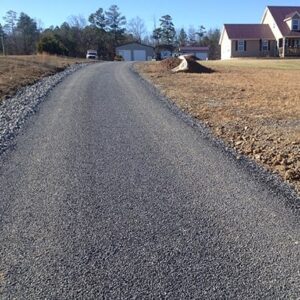
Gravel is a practical alternative for properties with long and winding entrances, especially in the more rural areas of Southern Anne Arundel County. The initial cost is lower than paved surfaces. This makes it a viable choice for expansive estates or farm properties. Gravel is naturally permeable. This allows rainwater to soak into the ground rather than running off into local storm drains, which can be an environmental advantage near the bay. However, a simple layer of stone is not enough for a lasting surface. A successful gravel driveway requires professional site grading and a compacted base to prevent the stones from sinking into the soil. Without this foundation, the driveway will quickly develop ruts and lose its shape.
Maryland’s freeze-and-thaw cycles affect these materials differently. Asphalt is flexible and can expand and contract, while gravel simply shifts and may need occasional raking or the addition of new stone. Your choice ultimately depends on how much time you want to spend on upkeep and the visual tone you want to set for your property. If you are ready to determine which material fits your land and budget, contact our team today to schedule a site visit and receive a detailed estimate for your project.
Choosing a Trusted Anne Arundel County Paving Contractor
Selecting the right team for your project is the final and most important step in the process. A new driveway installation that Anne Arundel County homeowners can rely on requires a contractor who understands the local geography and the region’s specific technical standards. You need a partner who views paving as a craft rather than just a quick job. This ensures that the structural integrity of your property is preserved for many years to come.
Trust is built on transparency and professional standards. When you review an estimate, look for a clear breakdown of the work. A reliable proposal should define the thickness of the stone base and the specific type of asphalt mix being used. In Maryland, homeowners should be cautious of door-to-door solicitors who claim to have leftover material from a nearby project. These offers are common paving scams that often result in thin, poor-quality surfaces that crumble after a single season. A reputable business will always provide a formal agreement and allow you the time to make an informed decision without pressure.
The Capital Paving & Sealcoating Difference
Our company has been a staple of the local community since 1956. This long history allows us to combine the logistical capabilities of a large operation with the personal touch of a family-run business. We have deep roots in the Gambrills and Annapolis areas, and we take great pride in the work we leave behind. Our team operates with a quality-over-shortcuts mentality. We know that a driveway is only as good as the preparation work that happens before the asphalt is poured.
We provide a full range of services to protect your investment over its entire lifespan. This includes expert site grading to manage water runoff and professional new residential driveways built to last. Our experience with both new construction and protective maintenance, such as sealcoating, means we understand how to keep pavement durable in the face of Maryland’s humid summers and icy winters.
Next Steps for Your Driveway Project
The first step toward a successful installation is a professional site evaluation. We visit your property to assess the current soil conditions, drainage patterns, and any potential obstacles. This thorough inspection allows us to provide an accurate plan that addresses the specific needs of your land. Once a project is scheduled, we guide you through the preparation process to ensure everything goes smoothly on the day of construction.
Preparing your property is simple but necessary. You will need to clear the work area of vehicles and equipment to give the paving crew and machinery full access. We handle the technical details and coordination from there. If you are ready to upgrade your home with a surface that offers both beauty and longevity, you can get your free new driveway estimate from Capital Paving & Sealcoating by contacting our office. We look forward to helping you build a driveway that serves your family for decades.
Building a Foundation for Your Property’s Future
A successful new driveway installation that Anne Arundel County homeowners can be proud of is the result of technical precision and careful planning. You now understand that a durable surface doesn’t just happen by accident. It requires a stable stone sub-base and a design that follows strict county drainage standards to prevent early failure. Managing these regulations and soil conditions correctly ensures that your investment remains a permanent asset to your home for many years.
Capital Paving & Sealcoating has provided reliable service to this community for over 24 years. We are a family-owned and operated business that has maintained high standards since 1956.
If you are ready to start your project with a team that values quality over shortcuts, we are here to help. You can Request Your Free Driveway Installation Estimate to begin the process. We look forward to providing a smooth and reliable surface that enhances your property for decades.
Frequently Asked Questions
Do I need a permit for a new driveway in Anne Arundel County?
You must obtain a Residential Driveway Access Permit for any project that creates a new entrance or modifies an existing one connecting to a county road. This requirement ensures that your driveway meets local safety and drainage standards. The county manages these applications through the Land Use Navigator system to verify that the entrance doesn’t interfere with public utilities or road maintenance.
How much does a new asphalt driveway cost in Maryland?
The investment for a new surface depends on several variables, including the total square footage and the specific site grading requirements of your property. Material costs are influenced by the monthly price index for asphalt ton rates in Maryland. Other factors like the depth of the stone base and the complexity of your drainage plan also determine the final project requirements.
How long does a new asphalt driveway take to cure before I can drive on it?
You should wait at least 48 to 72 hours before driving a standard passenger vehicle onto the new surface. While the asphalt feels solid within a few hours, it remains pliable and sensitive to weight for several days. The full curing process takes between six and twelve months. During this period, the asphalt hardens as the light oils in the mix naturally evaporate.
What is the best time of year to pave a driveway in Anne Arundel County?
The ideal window for paving runs from late spring through early autumn. Successful installation requires dry ground and consistent daytime temperatures above 50 degrees. If the air or ground is too cold, the hot mix asphalt will lose its heat too quickly. This prevents the crew from achieving the required density during compaction.
How thick should a residential asphalt driveway be?
A standard residential driveway typically consists of two to three inches of compacted asphalt. This surface layer must sit on a stable stone base that is usually 6 to 8 inches deep. If you intend to park heavy equipment or large recreational vehicles, both the base and the asphalt thickness should be increased to support the additional weight.
Can you pave a new driveway over an existing one?
Paving over an existing surface is possible through a process known as an overlay or resurfacing. This is a viable option if your current driveway is structurally sound and free of deep foundation cracks. If the underlying base has already failed or shows signs of significant sinking, a full replacement is necessary to ensure the new surface lasts.
How long will my new asphalt driveway last before it needs sealcoating?
You should wait approximately 12 months after a new driveway installation in Anne Arundel County before applying the first layer of sealant. This timeframe allows the new pavement to fully cure and release excess surface oils. Applying sealcoating too soon can trap these oils and prevent the asphalt from reaching its maximum hardness.
What causes a new driveway to crack or sink shortly after installation?
Early failure is almost always the result of poor sub-base preparation or inadequate drainage. If the soil beneath the driveway isn’t properly compacted or water pools under the pavement, the ground will eventually shift. This movement creates a void that causes the asphalt to crack or sink under a vehicle’s weight.